Release Notes
arivis Pro 4.5
Released: 2026-03-19
New & Noteworthy
- New data aggregation with heat map view for well plates directly in arivis Pro
- Export aggregation settings to arivis Hub and get the same results as in arivis Pro at a larger scale
- Preview feature: enable "Formula-based feature creation" to create new custom features using a mathematical formula
Multi Run & Aggregation (Batch license required)
- new: Aggregate Features operation in Analysis Pipeline
- new: pre-define statistical features as needed in the Aggregate Features operation (e.g. count, min, max, mean, ratio ...)
- new: use Multi Run in the Analysis Panel to run the pipeline and aggregate object features for multiple wells or fields of a well plate document
- new: Data Aggregation window to explore the aggregated values for the well plate
- new: show distribution of an aggregated value as heat map for the well plate in Data Aggregation window
- new: export pipelines with Aggregate Features settings to arivis Hub
- new: export aggregated results as XLS or CSV
- new: Multi Run adds a new tag "Multi Run" to allow filtering for the resulting objects of the same run easily
- improved: current image type is preselected for Multi Run
Analysis
- new: Formula-based custom feature allows to compute a feature based on a freely definable mathematical formula (Preview Feature)
- new: use values from referenced objects in Formula-based features to create e.g. ratio to parent
- new: 3D Feret Max object feature
- new: Maximum Inscribed Circle/Sphere features for filled objects
- improved: DL Reconstruction and DL segmenter remember model specifics in pipeline to recover custom settings in case the model is missing
- improved: allow duplicate channels to be used for DL Reconstruction or DL segmenter
- improved: several operations which export data (e.g as XLS or CSV) do better validation for the configures export name or path
- improved: don't try to use CUDA if support ist not installed or GPU is missing or disabled
- improved: determinism of Cellpose results on different machines/hardwares (please be aware: the results could slightly differ from 4.4 pipelines)
- improved: performance of Cellpose and DL inference (especially if running on CPU)
- improved: updated Matryoshka.python sample scrip
- change: using ONNX Runtime 1.23 and CUDA 12.9 now
- change: some demo data and the related sample pipelines have been updated
- fix: sometimes Cellpose operation did not deliver the same results as in previous versions of arivis Pro
- fix: some sample pipelines were using deprecated operations
- fix: DL Trainer had some issues with unicode characters in dataset names
4D Viewer
- improved: settings for export segments as surface use the same surface quality (and smoothing) as in the viewer
- improved: storyboards for data with more than 8 channels
- improved: show preview icon in viewer label while isosurface extraction dialog is open
2D Viewer
- improved: selected objects are visualized with a yellow outline now in the 2D Viewer (similar to the 4D Viewer)
- improved: object selection in 2D Viewer by left click + drag a rectangle is now updated live (Preview Feature)
- improved: left click + drag to select objects in the 2D Viewer can be started from everywhere (even inside an object)
Import & Data Handling
- improved: consider the PlateId for naming on import well plate datasets
- fix: wrong tile positions for PE well plate data without orientation matrix specified in the metadata
- fix: import problems for data from PE Acapella
- fix: for some CZI files it was not possible to hide some channels
- fix: set time does not work properly for some CZI files
General
- new: a link to request a trial license is available right from the License Selection dialog
- new: arivis Pro can be installed from the ZEISS Microscopy Installer (ZMI)
- change: arivis Pro stand alone installer provides Docker Desktop version 4.56.0 now
System requirements
- change: supported & tested platform is Windows 11
- change: arivis Pro requires a GPU providing CUDA compute capabilities ≥ 7.5 for ML/DL acceleration
- change: NVIDIA GPU minimum driver version is 576.02
- change: arivis Pro stand-alone installer provides Docker Desktop version 4.56.0
- change: Docker based instance segmentation requires NVIDIA GPU with CUDA Compute Capability ≥ 7.0 now
Misc
- improved: several updates & fixes for the help content
- improved: updated version of the ZEISS Help Viewer
- fix: potential crashes running in Windows 11 when operations on very large data sets run in parallel with many threads
- various smaller bug fixes and improvements
arivis Pro 4.4
Released: 2025-09-30
New & Noteworthy
- New Multi Run for the Analysis Panel: run the pipeline for multiple wells or fields of a well plate document
- Retain selected tags when switching between wells or image sets
- Accurately detecting cells and nuclei of varying sizes with the new Cellpose-SAM model
- More intuitive rotation in 4D Viewer using the trackball rotation mode
High Content Analysis
- new: run an analysis pipeline for selected well or fields with the new Multi Run mode
- new: interactively select wells and fields for the analysis multi run with a new well picker
- new: show hierarchical state and progress while running a pipeline over multiple fields and wells
- new: explore the results of already finished wells while the pipeline for other wells is still running
- new: stick to the currently selected tag selection while switching between different wells or fields
- new: stick to the current channel visibility while switching between different wells or fields
- new: distinguish different image types for a single well or field (e.g. fluorescence z-stack, bright-field or maximum intensity projection)
Analysis
- new: Convert Traces to Segments operation
- new: Cellpose-SAM (CPSAM) model is available in the Cellpose-based Segmenter operation
- improved: Segment Morphology operation has additional parameters for some methods
- improved: show a warning in the Batch Analysis if output files with the same name would be generated (and would overwrite each other)
- improved: DL reconstruction speed up by better utilization of GPU resources
- improved: better progress while downloading models from arivis Cloud AI Model Store
- improved: error handling for the Export Surfaces operation
- fixed: some minor bugs for the ML Trainer (Objects) and ML Trainer (Image)
- fixed: issues with the objects in the DL Trainer if classes or training has been renamed before drawing
- fixed: potential problem with continue training if multiple image sets are used in the DL Trainer
- fixed: some rounding issues in the max distance field of the Compartments operation
- fixed: potential crash with Magic Wand on CZI data
- fixed: a problem with large planes in CZI data if used with arivis Cloud models in DL Segmenter
- fixed: do not reset the object selection when switching viewer types (while showing objects from the Analysis pipeline)
General
- new: do not reset object filter (e.g. selected tag) when switching between image sets
- new: do not reset channel visibility when switching between image sets (with the same number of channels)
- new: the Preview Features dialog allows you to activate and test early results for newly added features
- new: the arivis Pro help content is provided by the ZEISS help viewer now
- improved: help content layout
Objects
- new: ability to represent feature values as colorful bars normalized to min / max of the Summary (if enabled)
- improved: detection in the AI-assisted mode in the Draw Tool for data zoomed > 100%
- improved: selection of (overlapping) objects in 2D
- improved: help content for object store types and the context menu of the Objects dialog
4D Viewer
- new: Quick Movie Export - export like you see it in the viewer
- new: intuitive rotation of 3D data using the trackball rotation mode
- new: dedicated Rotate tool
- new: improved positioning of clipping planes with handles
- improved: cursor feedback for axis-specific rotation with right mouse and XYZ key
- improved: more anti-aliased selection line
- fixed: prevent artifacts on volume boundaries with inverted opacity curve
- fixed: prevent object render problems with some specific NVIDIA driver versions
- fixed: avoid problems with missing permissions for the clipboard on copy / paste of opacity settings
Data Handling & Import
- new: import image type for well plate data (e.g. fluorescence z-stack, bright-field or maximum intensity projection)
- new: include image type (if available) in the default name for the imported image set
- improved: import tiled LaVision FastTile Blaze data
- improved: normalization of the color range for CZI float datasets
- improved: support added for more compression types of HDF5 blocks (e.g. used by some IMS datasets)
- fixed: potential wrong colors were imported from some Aperio-SVS data
- fixed: wrong pixel size imported from some Aperio-SVS data
- fixed: import of different image types as channels from Yokogawa
- fixed: import of BigDataViewer with non-consecutive setups
- fixed: some CZI appear blank if opened but not imported
Misc
- new: Docker Desktop is now an optional download in the arivis Pro installer
- new: includes a Docker Desktop license covering running arivis Cloud models in arivis Pro
- removed: Extended Focus has been retired
- several additional bug fixes and stability improvements
arivis Pro 4.3.1
Released: 2025-04-30
New & Noteworthy
- AI-assisted mode for the Draw Tool - precision and efficiency in manual segmentation workflows.
- Import Document Objects operations allows to copy stored features.
Improvments & Fixes
improved: easier adding CZI data to Batch Analysis
improved: allow download of CZI data from arivis Hub
improved: DL Trainer behavior while drawing at different image sets
fix: object store cache for CZI data uses correct extension now (e.g. filename.czi.cache)
fix: wrong well or field assignment for some scenes in CZI data
fix: scaled analysis could cause artifacts with sparse CZIAnalysis:
fix: DL Trainer - drawn objects were colored wrong (if class was renamed before drawing)
fix: Compartments operations did not store the inputs correctly if the same input was in use multiple times
fix: intensity features are listed under the segments category again
fix: instance segmentation (working on modified channel data) writes results to the correct time point more stable
fix: using trace objects in Python script operation
General
improved: Draw tool visualizes the merging of shapes directly when drawing with the brush* change: arivis License Tool requires .Net 8 now* additional smaller fixes
arivis Pro 4.3
Released: 2025-03-11
New & Noteworthy
- AI-assisted Spine Tracing: automated spine detection using pre-trained Al models or other methods.
- Enhanced Cell Measurements: expanded measurement capabilities enabling richer feature sets.
- Native CZI Support: open, visualize and analyze CZI data, with no intermediate conversion steps needed.
- Remote Docker: run instance segmentation with the help of a satellite / remote Linux system.
Deep Learning / Machine Learning
- new: DL Trainer preview - verify the trained model right in the DL trainer panel
- new: tile blending option for DL reconstruction operation
- new: option to specify the normalization range to be applied on the data before inference
- new: confidence feature value for instance segmentation results
- new: option to run instance segmentation with the help of a remote Docker engine
- new: arivis Cloud preference page
- new: option to adjust normalization range for Cellpose operation
- improved: improved consistency for CUDA based calculations (e.g. Cellpose)
- improved: better help and guidance for running instance segmentation based on ZEISS arivis Cloud models
- improved: AI model store sorts list by creation time now
- improved: AI models store displays the model's author
- improved: do not show and store arivis Cloud access token in clear text anymore
- improved: order of classes in the DL trainer is reversed (the same as in arivis Cloud now)
- fix: prevent "Could not reach the instance segmentation service" for some specific Docker setups
- fix: ML Segmenter - under some conditions, segments were not found on the last plane
- removed: sync with channel visibility in ML Trainer
Tracing
- new: Spine Tracer operation to detect spines and extend existing traces
- new: AI assisted spine detection in the Spine Tracer operation
- new: spine counting and spine density object features
- new: SWC export respects selection
- fix: Neuron Tracer - make sure all neurites are connected to a cell body (if configured)
Analysis & Objects
- new: SD (standard deviation) added for a lot of features
- new: morphological segment features (convex hull, cross section area, equivalent ellipse projection, maximum inscribed sphere, inscribed disk)
- new: additional 2D segment features (symmetry 2D, Feret projection, convex hull projection)
- improved: Seeded Region Growing supports more and larger seeds
- improved: object styles parent filter allows to select trace type
- improved: updated ITK version (fixes cancellation issues)
- improved: progress in the Store Objects operation during surface pre-calculation
- improved: error handling in the Import Surfaces dialog
- improved: group statistics for traces
- improved: more detailed descriptions for object feature calculations in the help
4D-Viewer
- new: arivis Pro tries to active high performance graphics automatically
- improved: optimized progressive strategy for object visualization
- improved: surface calculation creates smoother objects with less terracing artefacts
- improved: selection of objects behind an active clipping plane
- improved: unified memory limit warnings for traces and segments
- improved: performance for the track tool in 4D
- fix: avoid block artefacts for storyboard movies with time series data
Data Handling & Import
- new: open CZI data natively without the need for import
- new: Thermo Fisher CellInsight CX7 media handler
- improved: background correction performance for large data
- improved: Meta Image Series / ImageXpress import
- improved: support for JPEG2000 compressed TIFF data
- fix: image set names for well plate datasets (e.g. from ImageXpress or Yokogawa)
- fix: potential import problems for 32bit float TIFF data
- fix: problems importing multimodal Yokogawa data
- fix: some VSI were imported with a wrong channel order
- fix: potential problems with export objects as labelled images
- fix: import *.am data from Avizio
- fix: import of stitched LaVision datasets
General
- new: unified Pan tool (previously Drag tool in 2D)
- new: allow panning in 2D and 4D Viewer (independent of the active tool) by middle mouse drag
- fix: prevent selection of non editable objects in the Draw Tool (e.g. track or trace)
- removed: deprecated Python script API functions ImageSet.get_pixel and ImageSet.set_pixel
- switched to .Net 8 * numerous additional bug fixes and stability improvements
arivis Pro 4.2
Released: 2024-06-18
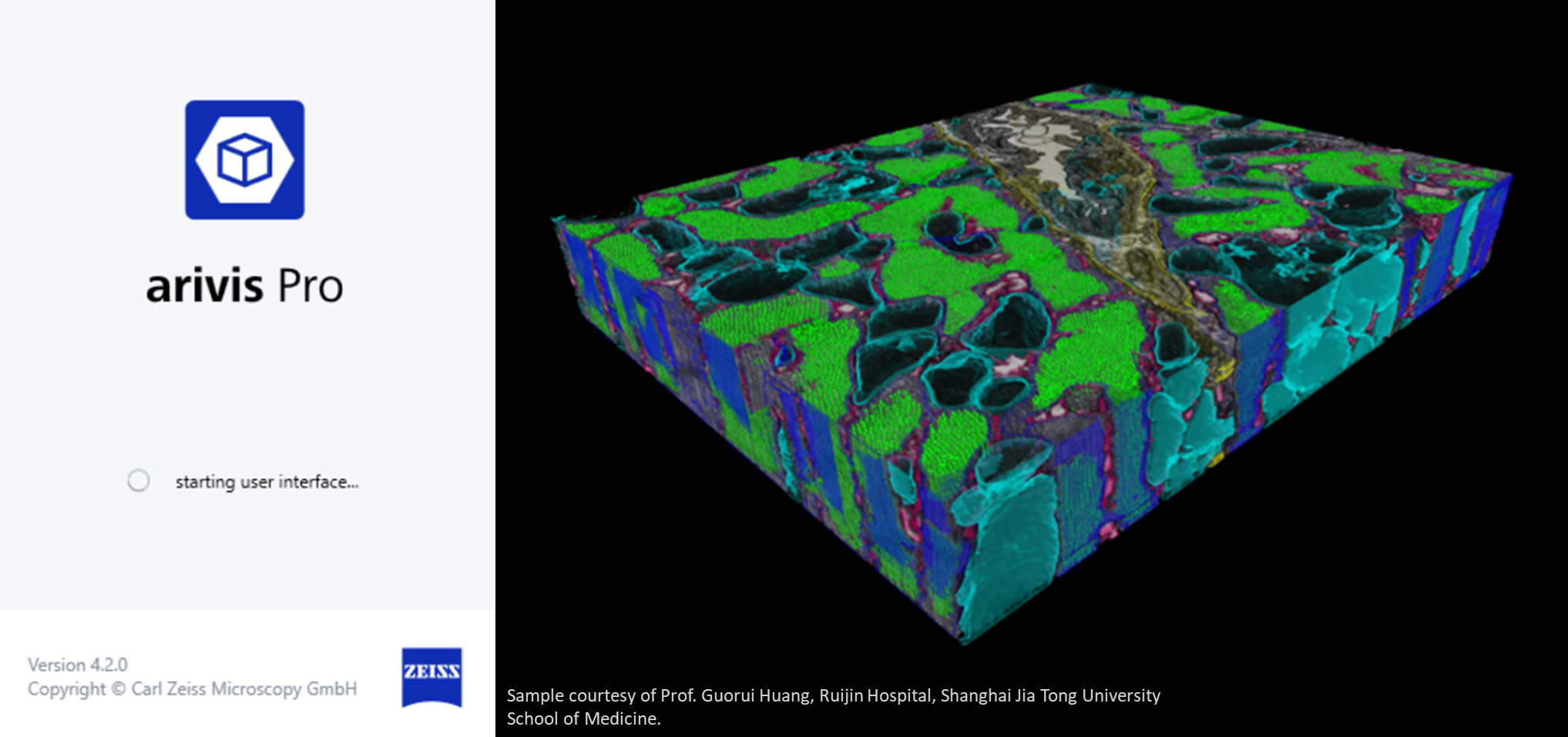
ZEISS arivis Pro 4.2 (formerly Vision4D) offers users the freedom to select the most suitable image analysis method for their needs. The new release includes enhanced AI-driven tools, 3D analysis capabilities, and large dataset handling. The software allows for unprecedented flexibility to tailor microscopy image analysis workflows to answer research questions.
New & Noteworthy
- Optimized meshing and rendering for unlimited numbers of objects in the 4D Viewer
- Instance (object-based) segmentation driven by Deep Learning models from arivis Cloud AI Model Store
- Cells and nuclei segmentation in microscopy images using the Cellpose operation
- High precision preview in the Analysis Pipeline can work on 3D data to produce a more meaningful preview
Other Optimizations
- Analysis can directly show a preview in the 4D Viewer for object creation operations (e.g. Neuron Tracer)
- Machine Learning can auto-optimize the used feature set to improve performance
- Improved handling for huge amounts of objects in the objects table
- Rebranding is completed: The software is now called ZEISS arivis Pro
arivis Vision4D 4.1.2
Released: 2023-11-11
Cellpose Segmenter
- improved: better memory checks to avoid internal errors
- improved: more clear error and warnings
- improved: better description of the available pre-trained models in the help
- change: perform planewise is enabled by default now
- fix: handling of results for time points other than the first one (in combination with voxel filters)
- fix: normalization for data with bias in min intensity value
- fix: other small fixes for the Cellpose Segmenter
Import
- improved: importing channel names for XDCE data
- fix: import problems for some ND2 time series
General
- improved: faster free consumed license after quit of the application